Successful RESET Study Visit at the University of Alicante Strengthens Research Management Capacity for Green Growth in Lao PDR
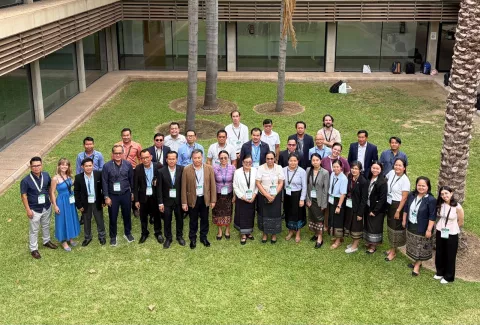
The RESET consortium has successfully concluded its first international Study Visit, hosted by the University of Alicante (UA), marking a major milestone in the implementation of the Erasmus+ Capacity Building project RESET – Redefining Research Management Structures and Research Career Development to Accelerate Green Growth in Lao PDR.
Coordinated by Champasack University (CU) and co-funded by the Erasmus+ Programme of the European Union, RESET aims to strengthen research management systems and research career development across Lao higher education institutions. By fostering institutional capacity, promoting international cooperation and supporting evidence-based research, the project contributes to building a more innovative, sustainable and resilient higher education ecosystem aligned with Lao PDR's green growth agenda.
The two-day Study Visit brought together representatives from all consortium partners, including senior university leaders, research managers and officials from the Ministry of Education and Sports of Lao PDR (MoES). The event provided a unique platform for peer learning, exchange of good practices and strategic discussions on how successful European research management models can be adapted to the Lao context.
The RESET consortium comprises:
- Champasack University (CU) – Project Coordinator
- National University of Laos (NUOL)
- Souphanouvong University (SU)
- Savannakhet University (SKU)
- University of Health Sciences (UHS)
- Ministry of Education and Sports (MoES)
- University of Alicante (UA), Spain
- Albert-Ludwigs-Universität Freiburg (ALU), Germany
- CESIE ETS, Italy
The programme opened with institutional welcome remarks by Juan Llopis, Director of Institutional Relations and Projects at the University of Alicante; and Carolina Madeleine, Director of the Institutional Project Management Office (OGPI). Their interventions highlighted the strategic role of international cooperation, robust research support structures and talent development in strengthening universities' capacity to address global challenges through research and innovation.
Throughout the first day, participants explored key components of the University of Alicante's research ecosystem. Sessions covered the organisation and international dimension of the University's Doctoral School, institutional research management services and administrative processes, the DigiHaz project as an example of researcher training and capacity building, and the role of the Service for Research Management in supporting researchers throughout the project lifecycle. These exchanges provided practical insights into how comprehensive support structures can enhance research excellence and career development.
The second day focused on innovation, knowledge transfer and the strategic planning activities that RESET partners will implement in Lao PDR. Participants learned about the governance and services of the UA Science Park, the University's Technology Transfer Office and its technological portfolio, as well as the institutional support mechanisms available for the creation of technology-based companies. The programme also included a presentation by the International Economics Institute (IEI) on its structure, research activities and projects related to circular economy and sustainability, illustrating how research can directly contribute to sustainable development and regional impact.
Beyond the technical sessions, the programme also fostered networking and institutional dialogue, including an official meeting with the Rector of the University of Alicante and social activities that further strengthened collaboration and mutual understanding among consortium members.
The successful completion of this Study Visit represents an important step towards achieving RESET's objectives. By combining European expertise with the priorities and ambitions of Lao higher education institutions, the consortium continues to build a shared vision for modern, efficient and sustainable research management systems that will enhance research quality, strengthen institutional capacity and create new opportunities for researchers, ultimately contributing to green growth and sustainable development in Lao PDR.
For more information about RESET, visit https://www.resetlaopdr.eu and follow the project on its social media channels Instagram, Facebook, LinkedIn, and YouTube to stay updated on the latest news, activities, and achievements.
Follow RESET on