RESET Project Officially Launched to Transform Research Capacity and Career Development in Lao PDR
The RESET project was formally launched on 1 January 2026, marking the beginning of an ambitious and strategically significant initiative aimed at strengthening the research and innovation landscape of the Lao People’s Democratic Republic. From its inception, RESET has positioned itself as a structural response to the long-standing capacity-building needs of Lao Higher Education Institutions (HEIs), with a particular focus on modernising research management systems and establishing sustainable and transparent career pathways for researchers in priority areas linked to Green Growth.
A transformative vision for research in Lao PDR
RESET seeks to address systemic and structural barriers that have historically constrained the development of high-quality research and limited professional prospects for researchers in Lao HEIs. By combining institutional reform, targeted capacity-building, and national-level policy dialogue, the project introduces a comprehensive and forward-looking approach to research development.
At its core, RESET aims to:
- empower researchers through advanced training programmes, relevant skill sets, innovative tools, and tailored support services;
- modernise research management structures and strategies at institutional level;
- contribute to the creation of a national policy framework fostering clear, sustainable, and merit-based research career pathways in fields that underpin Green Growth.
A central and pioneering component of the project is the establishment of a National Research Hub, conceived as the intellectual and operational heart of RESET. This hub will make it possible to map and consolidate the country’s critical mass of researchers, deliver training opportunities at all career stages, and significantly enhance collaboration across institutions and disciplines.
A strong and diverse international consortium
RESET brings together a distinguished and multidisciplinary consortium that reflects a balanced partnership between Lao institutions, European universities, and specialised organisations.
Lao partners:
- Champasack University (CU) – Project Coordinator
- National University of Laos (NUOL)
- Souphanouvong University (SU)
- Savannakhet University (SKU)
- University of Health Sciences (UHS)
- Ministry of Education and Sports (MoES)
European partners:
- University of Alicante (UA), Spain
- Albert-Ludwigs-Universität Freiburg (ALU), Germany
- CESIE ETS, Italy
This collaborative structure ensures the effective transfer of expertise, the sharing of good practices, and the development of solutions that are both internationally informed and locally embedded.
Early coordination and project governance
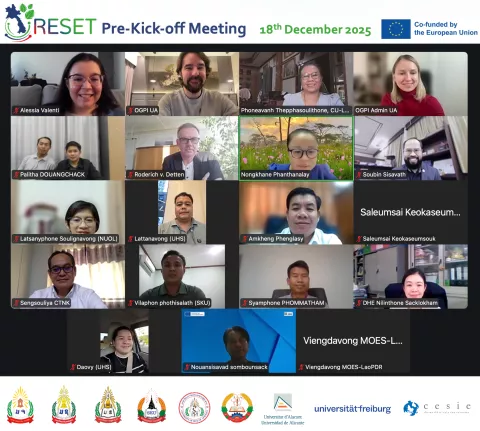
The consortium convened its first coordination meeting in an online format, focusing on a comprehensive understanding of the project’s objectives, work packages, governance structure, and the specific roles and responsibilities of each partner. This initial exchange laid out the groundwork for efficient implementation, shared ownership, and a common strategic vision.
The first in-person consortium meeting is scheduled to take place from 4 to 6 March in Champasack, Lao PDR, hosted by Champasack University, the project coordinator. This milestone gathering will represent a key moment for operational planning, peer learning, and strengthening institutional cooperation among all partners.
Long-term impact and sustainability
RESET’s expected results extend beyond institutional capacity-building. Through enhanced cooperation between higher education institutions, public authorities, and the wider research and innovation ecosystem, the project will generate publishable outputs and reference materials designed to ensure long-term impact, scalability, and replicability.
By aligning research capacity development with national priorities for Green Growth, RESET contributes not only to the advancement of academic excellence but also to the socio-economic and environmental sustainability of Lao PDR.
With its official launch on 1 January 2026, RESET has entered a decisive phase that sets in motion a transformative process for the country’s research landscape — one built on partnership, innovation, and a shared commitment to sustainable development.
Follow RESET on